
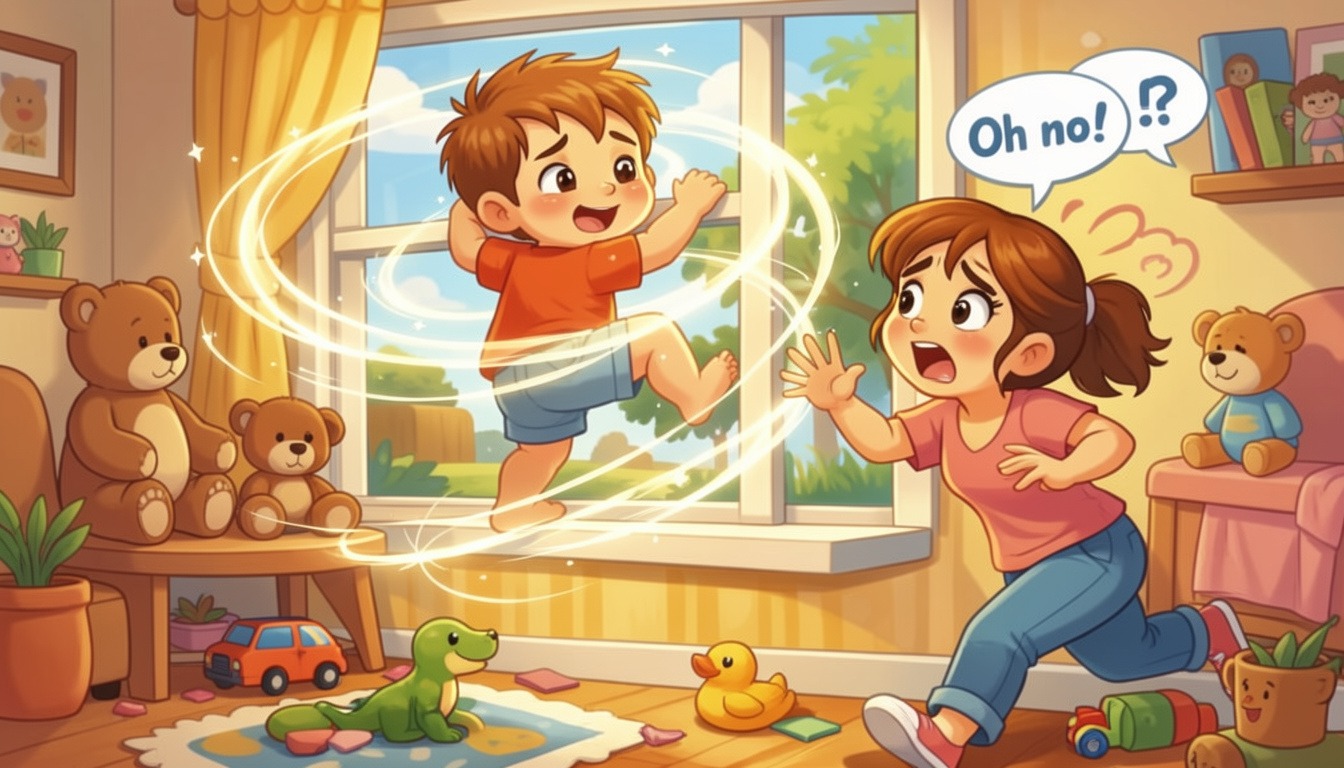
Why Your Child’s Energy is Their Greatest Asset
We’ve all been there: you’re trying to have a quiet moment, and your child is treating the living room sofa like an Olympic gymnastics floor. In those moments, it’s easy to see all that high energy as a “problem” that needs to be managed or, let’s be honest, toned down.
But what if we looked at that constant movement differently? For young children, “wiggling” isn’t a sign of defiance or a lack of focus. It is actually the primary engine for their brain development. Think of movement as the biological “software update” for a growing mind. Physical activity isn’t just about using energy. Research shows it plays an important role in building a child’s overall development. It builds foundation for:
- Emotional Balance: Movement helps children release big feelings and feel calmer in their bodies.
- Brain Power: Active play strengthens brain connections that support learning in school later on.
- Life Skills: Building the coordination and confidence they need to navigate the world.
When we see movement as a milestone to support rather than a behavior to fix, we stop working against a child’s natural instincts and start fueling their future.
The Science: Why “The Itch to Move” is a Superpower
In the world of early childhood development, we talk about movement as a “biological imperative.” For children under six, the brain and body grow together, not separately. Every time a child moves, climbs, runs, or explores, their brain is growing right along with their body
1. Movement is Brain-Building
Think of physical activity as the “construction crew” for your child’s mind. When your child is climbing a tree or sprinting across the grass, they aren’t just “playing.” They are developing their Executive Function.
Think of this as the brain’s “Air Traffic Control” system. It helps them:
- Focus on a task without getting distracted.
- Problem-solve when something doesn’t go their way.
- Control impulses (practicing the “brakes” on their behavior).
2. The “Goodness of Fit”: It’s Not the Child, It’s the Room
There is a famous concept in psychology called “Goodness of Fit.” It suggests that most “behavior problems” aren’t actually problems with the child; they are just a mismatch between the child’s energy and the environment they are in.
The Reality Check: If you put a high-energy child in a “sit still and be quiet” room, you’re going to get friction. That’s not a “naughty” kid; that’s a high-performance engine idling in a school zone. When we change the environment to allow for movement, the “disruptive behavior” often disappears.
3. The 180-Minute Goal
The World Health Organization (WHO) has a specific “prescription” for healthy development. It might sound like a lot, but here is the breakdown for toddlers and preschoolers:
- Total Daily Movement: 180 minutes (3 hours) spread throughout the day.
- The Intensity: For preschoolers, at least 60 minutes of that should be “heart-pumping” play, the kind where they get a little sweaty and out of breath.
The Indian Perspective: More Than Just “Exercise”
In India, we are seeing a massive shift in how we think about school and home life. The National Education Policy (NEP 2020) and the National Curriculum Framework (2022) have officially moved away from the old-school idea that “learning only happens while sitting still.”
The Five Layers of a Child (Panchakosha)
Our modern educational guidelines are actually rooted in an ancient Indian concept called Panchakosha, or the “five-fold development” of a human being.
The very first layer is the Annamaya Kosha (the physical layer). The framework is clear: you cannot build a strong house without a solid foundation. If a child’s physical need for movement isn’t met, the other layers, like their emotions and their intellect, don’t have a stable place to grow.
Goodbye “Sit-Down” Teaching
The latest guidelines (NCF-FS) actually discourage making toddlers sit at desks for long periods. Instead, they advocate for Activity-Based Learning. This means movement isn’t a break from the lesson; movement is the lesson.
The Urban Challenge: Space vs. Need
We know that in many Indian cities, space is a luxury. Between small apartments and busy streets, it’s tempting to keep children quiet and “managed.”
However, the new framework challenges us to get creative. It’s a shift in mindset:
- Old way: Managing children into silence.
- New way: Supporting children through movement-rich environments (even in small spaces!).
Whether it’s a yoga stretch in the morning, a quick game of “Simon Says” in the hallway, or using a local park, we are being asked to prioritize our “physical layer” so we can thrive everywhere else.
From “Naughty” to “Needing”: A Tale of Two Perspectives
To see how this works in the real world, let’s look at Raha, a busy three-year-old who just won’t stop jumping off the sofa.
Depending on which “lens” you wear, the way we look at her behaviour completely changes the story.:
1. The “Management” Lens (Focus on Control)
When we are tired or stressed, we see a safety risk. We see a child who isn’t listening.
- The Thought: “Why can’t she just sit still? She’s going to hurt herself or break something.”
- The Reaction: “No!” “Stop that!” “Sit down and be quiet.”
- The Result: Raha feels frustrated because her body still has that “itch,” and the adult feels like they’re in a constant power struggle.
2. The “Developmental” Lens (Focus on Growth)
When we look more closely, we see a child conducting a science experiment on herself. Her nervous system is actually craving two specific things:
- Proprioception: Feeling the “thud” helps her brain understand where her body ends, and the world begins.
- Vestibular Input: That “flying” feeling helps her develop balance and spatial awareness.
- The Thought: “Raha’s nervous system is looking for feedback. She’s trying to get ‘regulated’ so she can feel calm.”
- The Reaction: Instead of a flat “No,” we offer a “Yes, but…” (e.g., “The sofa isn’t for jumping, but you can jump on these cushions on the floor!”).
- The Result: Raha gets the sensory input her brain needs, the sofa stays safe, and the power struggle disappears.
From “No” to “How”: Practical Ways to Support Your Child
Supporting a high-energy child doesn’t mean letting them run wild; it means shifting our focus from restricting movement to redirecting it. Here are three research-backed ways to make that happen:
1. Change the “Vibe” of the Room (Create “Affordances”)
Kids don’t see a “bookshelf”, they see a “ladder.” They don’t see a “hallway”, they see a “racetrack.” This is because children look at objects based on what they can do with them.
- At Home: If the bookshelf is off-limits, create a “Yes Zone.” Pile up some firm cushions for a “climbing mountain” or invest in a small indoor climbing frame (like a Pikler triangle).
- In Schools: Transition times (like moving from the play area to lunch) are perfect for movement. Instead of asking kids to “walk in a quiet line,” ask them to “hop like frogs” or “tiptoe like ninjas.”
2. Use the Power of “Heavy Work.”
Have you ever noticed how a child seems calmer after helping carry groceries or pushing a heavy box? Occupational therapists call this “Heavy Work.” These activities push or pull against the body, which helps the nervous system feel grounded and “organized.”
Try these simple tasks:
- Ask them to help “drive” the laundry basket to the washing machine.
- Have them “help” move a stack of books from one shelf to another.
- Let them wear a small backpack with a favorite book inside while you walk.
3. The “Outdoor 60” Rule
Science is very clear on this. Children who spend more time outdoors have better motor skills and fewer meltdowns. Even in a busy city, that “connection to the outside” is vital.
Your Goal: Aim for at least 60 minutes of unstructured outdoor play every day.
- No park nearby? Use your building’s corridor for a game of “Red Light, Green Light.”
- Small balcony? Set up a “movement station” with a hopscotch grid made of tape.
The Bottom Line
When we stop seeing high energy as a “behavior problem” and start seeing it as a brain-building requirement, everything changes. By providing the right outlets for movement, we aren’t just “tiring them out”; we are helping them build the foundation for a focused, calm, and capable life.
Common Myths vs. Evidence-Based Reality
| Myth | Evidence-Based Reality |
| “He just needs to learn to sit still for school.” | Sitting still is a physical skill that requires core strength and postural control, developed through movement (NAEYC, 2020). |
| “Giving him more space will make him more wild.” | Research shows that “open-ended” play spaces actually reduce aggressive behavior because children don’t have to compete for physical “territory” (Legendie et al., 2017). |
| “High energy is a sign of ADHD.” | While ADHD involves hyperactivity, most high energy in toddlers is a developmental norm. Diagnosis is rarely appropriate before age 4–5, as activity levels are naturally high in early childhood (CDC). |
Knowing When to Ask for a Helping Hand
While we’ve established that high energy is a sign of a healthy, growing brain, sometimes a child’s “engine” might be running a bit too fast for them to handle on their own. In some cases, a child might be struggling with how their brain processes sensory information.
It’s always okay to trust your gut. You might want to chat with a pediatrician or a child psychologist if you notice these “Red Flags”:
- Safety Blindness: If your child’s movement is consistently unsafe and they don’t seem to develop a “sense of danger,” even after you’ve taught them many times.
- The “Always-On” Motor: If they seem “driven by a motor” and literally cannot stop moving, even for just a minute or two for something they actually love, like their favorite bedtime story.
- Extreme Transitions: If moving from one activity to another (like leaving the park) consistently leads to extreme distress that feels way beyond a typical toddler tantrum.
- Sleep Struggles: If their high activity level makes it nearly impossible for their body to “power down” for sleep at night.
The Big Takeaway: A child who cannot sit still isn’t trying to be difficult. Most of the time, they are simply a child whose nervous system is telling them, “I need to move so I can learn.”
When We Let Them Move, We Let Them Grow
If you remember nothing else from today, keep these five points in your back pocket:
- Movement is Brain Fuel: Every time your child runs, jumps, or climbs, they are building the neural pathways for memory and focus. They aren’t just “playing”, they’re “wiring” their brain.
- The 3-Hour Target: Aim for 180 minutes of total movement throughout the day. It doesn’t have to be all at once; short bursts of energy count!
- Check the Room, Not Just the Child: If your little one is acting out or seems “extra,” take a look at their surroundings. Is the environment too quiet or too restrictive? Sometimes a change of scenery (or a quick “movement break”) is the best “discipline.”
- Don’t Forget “Heavy Work”: When in doubt, let them push, pull, or carry. These “heavy” tasks are like a reset button for a restless nervous system.
- The Policy is on Your Side: Remember, India’s latest educational guidelines (NCF-FS 2022) officially support you. We are moving away from desks and towards “Play-Way” learning because that is where real growth happens.
Sources & Further Reading
- American Academy of Pediatrics. (2018). The Power of Play: A Pediatric Role in Enhancing Development in Young Children. Pediatrics, 142(3). https://doi.org/10.1542/peds.2018-2058
- Bidzan-Bluma, I., & Lipowska, M. (2018). Physical Activity and Cognitive Functioning of Children: A Systematic Review. International Journal of Environmental Research and Public Health, 15(4), 800. https://doi.org/10.3390/ijerph15040800
- Carson, V., et al. (2017). Systematic review of physical activity and health indicators in the early years (aged 0–4 years). Applied Physiology, Nutrition, and Metabolism. https://doi.org/10.1139/apnm-2016-0620
- Gibson, J. J. (1979). The Ecological Approach to Visual Perception. Houghton Mifflin. (Landmark Theory)
- Ministry of Education, India. (2022). National Curriculum Framework for Foundational Stage (NCF-FS). NCERT.
- NAEYC. (2020). Developmentally Appropriate Practice (DAP) Position Statement. National Association for the Education of Young Children.
- Thomas, A., & Chess, S. (1977). Temperament and Development. Brunner/Mazel. (Landmark Theory)
- World Health Organization. (2019). Guidelines on physical activity, sedentary behaviour and sleep for children under 5 years of age. WHO Press.